Split system air conditioning is the most practical cooling solution for Queensland homes — efficient, relatively compact, and suited to most residential spaces. But the cost of installing split system air conditioning varies considerably depending on the unit you choose, the conditions of your installation, and what’s actually included in the quote. Understanding what drives the price helps you compare options properly, rather than just picking the lowest number.
This guide breaks down the real cost to install an air conditioner split system in Brisbane and the Moreton Bay region — what affects the price, what HSJ’s installations include, and what else you should factor into your thinking before you commit.
What’s Included in the Installation Cost?
A split system installation quote typically bundles the unit and the installation together, though some installers quote them separately if you’re supplying your own equipment. The unit cost is shaped by brand, capacity, energy star rating and features.
The installation component is where the variation matters more than most people realise. A complete, compliant installation should include:
- indoor and outdoor unit mounting hardware,
- the copper refrigerant pipe run,
- all ductwork and drainage connections,
- electrical isolation and protection devices,
- and sign-off by an ARCtick licensed technician.
You can search an ARC licence number using the Australian Refrigeration Council License Check.
At HSJ’s our installation packages include:
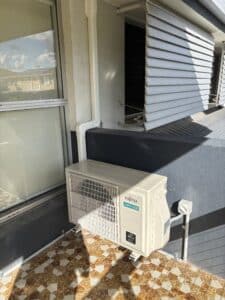
- A powder-coated wall bracket or slab for secure outdoor mounting,
- 20-amp AC isolator installed to safety standards,
- an RCBO protection device on systems 5kW and above,
- Up to 3 metres of insulated copper gas piping,
- All required ductwork and system connections,
- Installation by a qualified Arctick licensed technician.
That scope is fixed across all packages. What changes is the unit you select and the conditions of your specific installation.
What Affects the Cost of Installing a Split System?
Unit Capacity
Unit capacity is the most direct cost driver. A 2.5kW system for a single bedroom sits at a different price point to an 8kW system needed for a large open-plan living area — and getting the size right matters beyond the purchase price. An undersized unit runs continuously trying to keep up, wearing itself out faster than it should. An oversized unit short-cycles, which affects humidity control and wastes energy. A proper assessment of the space before selecting a system saves money in the long run.
Required Pipe Length
Pipe run length is another variable that catches people off guard. HSJ’s packages include up to 3 metres of copper gas piping — the standard scope for a back-to-back installation. Where the pipe run needs to exceed 3 metres, an additional $100 per metre applies. This is standard across the industry and reflects the extra materials and labour involved. If your preferred outdoor unit position requires a longer run, it’s worth knowing upfront rather than at invoice.
Wall Construction and Site Access
Wall construction and site access affect both complexity and time. Brick walls, double brick, high ceilings, restricted roof space, and non-standard drainage routes all add to the job. A quote based on your actual installation conditions is always more reliable than a flat rate applied without a site assessment.
Brand and Model
Brand and model selection shapes both the upfront cost and the long-term running cost — more on that below.
Switchboard Upgrades
Finally, older properties may require a switchboard upgrade before a new circuit can be added legally. It’s not always needed, but it’s worth raising with your installer early rather than discovering it on installation day. As a licensed electrician, HSJ offers electrical services and can upgrade your switchboard if required.
Split System Air Conditioner Installation Cost in Brisbane: HSJ’s Pricing
HSJ’s split system packages are supply-and-install, inclusive of all installation components listed above. Pricing is published on our air conditioning installation page, and current supply-and-install rates are as follows (all prices inc. GST):
Haier Quartz Series
Cost-effective performance for budget-conscious installations:
- 2.5kW from $1,810
- 3.5kW from $2,050
- 5.0kW from $2,455
- 6.0kW from $2,760
- 7.0kW from $2,910
- 9.0kW from $3,660
Fujitsu Airstage Series
Quiet operation suited to bedrooms and living areas where noise levels matter:
- 2.5kW from $2,000
- 3.5kW from $2,220
- 5.0kW from $2,750
- 7.0kW from $3,080
- 8.5kW from $3,920
Mitsubishi Heavy Industries Avanti Plus / Bronte Series
Reliable cooling performance for consistent day-to-day residential use:
- 2.5kW from $2,080
- 3.5kW from $2,280
- 5.0kW from $2,775
- 6.3kW from $3,175
- 7.1kW from $3,370
- 8.0kW from $4,020
Daikin CORA / XL Series
Advanced energy efficiency and feature set for homeowners prioritising long-term performance:
- 2.5kW from $2,100
- 3.5kW from $2,345
- 5.0kW from $2,820
- 6.0kW from $3,070
- 7.1kW from $3,270
- 8.0kW from $3,960
Please note that all pricing is a guide — final cost depends on system selection, property layout, and installation complexity. HSJ provides free quotes with clear, upfront pricing before any work proceeds.
Replacing an Existing System vs. New Installation
Replacing a split system is often more straightforward than a new install. The wall penetrations exist, the drainage route is established, and an electrical circuit is already in place. However, that doesn’t automatically mean it’s cheaper. If the old system used an outdated refrigerant type, or the existing pipe work and electrical connections don’t meet current standards, a competent installer will identify and address that rather than reuse infrastructure that will cause problems later.
Where the replacement is genuinely like-for-like and the existing installation is sound, the cost is typically comparable to a standard new installation — unit plus installation labour at the applicable package rate.
How Much Does It Cost to Run Air Conditioning?
Running costs are where inverter split systems deliver their real advantage. Unlike older fixed-speed systems that operate at full capacity until a target temperature is reached and then switch off entirely, inverter models vary their compressor speed to match demand. Once the room is at temperature, the system maintains it at a fraction of its rated capacity — considerably less energy consumption than the cycling on-and-off approach.
In South East Queensland, where electricity is typically priced around 30–35 cents per kilowatt-hour, a 2.5kW inverter split system running under normal conditions might consume 0.5–0.7kW per hour, costing roughly 15–25 cents per hour. A 6kW unit in a larger space might run at 40–55 cents per hour. Over an 8-hour day, that places a bedroom system at around $1.20–$2.00 per day, and a larger living area system at $3.20–$4.40 per day.
The actual figure shifts depending on your unit’s energy star rating, your specific electricity tariff, and how hard the system is working against the ambient temperature outside.
How to Run Your Split System More Energy Efficiently
The thermostat setting has the biggest single influence on running costs. Every degree lower during cooling increases energy consumption. Setting your system to 24–26°C in Queensland balances comfort and efficiency. Pushing it to 20°C doesn’t just cost more to reach that temperature; it costs more to hold it, especially on days above 35°C.
A few habits make a practical difference. Keep the room closed off while the system is running. Use ceiling fans to circulate conditioned air more evenly, which reduces how hard the split system needs to work. Clean the filters regularly — every few weeks during heavy summer use is ideal, because a clogged filter forces the unit to draw harder to move air, increasing both energy consumption and wear on internal components.
Pre-cooling is also worth considering. Getting a room down to a comfortable temperature before the peak heat of the afternoon is more efficient than trying to pull it down from 38°C when you walk in. The system reaches temperature faster and settles into its lower-power maintenance mode sooner.
How Many Rooms Will One Split System Cool?
A split system conditions the zone it’s installed in — not the whole house. Whether it can serve multiple rooms depends on whether those rooms are open to each other or separated by walls and doors.
As a general sizing guide: a 2.5kW system suits a bedroom or small room; a 3.5kW system handles a medium bedroom or small living area; 5–6kW systems suit large living areas or open-plan spaces; and 7kW-plus systems are appropriate for large open-plan areas or multiple connected spaces. Rooms with high ceilings, significant west-facing glazing, or poor insulation may need to go a size up from what the floor area alone suggests.
For whole-home cooling, a multi-split system — where multiple indoor units connect to a single outdoor unit — is often the practical solution. HSJ designs and installs multi-split systems configured to balance performance and efficiency across multiple zones, which suits homes where running a separate outdoor unit per room isn’t practical or preferred.
Can You Control Your Split System from Your Phone?
Most current residential split systems from Mitsubishi Heavy Industries, Daikin, Haier, and Fujitsu offer wifi connectivity — either built in or available via an optional adaptor — allowing remote control through a smartphone app. Turning the system on before you arrive home, adjusting the temperature from another room, or confirming it’s been turned off after you leave are all standard functions across most mid-range and premium models.
Bluetooth control is less common in residential split systems. Wifi is the practical standard for remote operation. It’s worth confirming whether Wi-Fi is included or an optional add-on when comparing models at the lower end of the price range, as it isn’t universally standard across all entry-level units.
Licences and Compliance: What to Confirm Before You Book
Split system installation in Queensland requires two separate licences: a Queensland Electrical Contractors Licence and an Arctick refrigerant handling licence. Without both, an installer cannot legally complete the full scope of work — the electrical connections and the refrigerant lines are separate regulated activities.
HSJ Electrical & Air holds both:
- QLD Electrical Contractors Licence No. 1505283
- QLD Arctick Licence No. L213992
Every installation is completed to Australian standards. Both licences are verifiable through the relevant Queensland regulatory bodies — if you’re booking any electrical or air conditioning work, confirming credentials beforehand is always a reasonable step.
Split System Installation Across Morayfield and North Brisbane
HSJ Electrical & Air installs split systems across Morayfield, Caboolture, Beachmere, Strathpine, Woodford, and the wider Moreton Bay region. Family-owned and operated with over 16 years of industry experience, every installation covers system selection, assessment, compliant installation, and full testing and handover — so you understand your system and it performs as it should from day one.
View our air conditioning pricing and packages or get in touch for a free quote.